

Introduction
When Creedence Clearwater Revival released “Fortunate Son” in 1969, the song quickly became a rallying cry for those disillusioned by the Vietnam War and the systemic inequalities surrounding the draft. The song, written by John Fogerty, peaked at No. 3 on the Billboard Hot 100 and strongly resonated with working-class Americans at the time. Fogerty wrote the song in just 20 minutes, though he later reflected that it had taken him much longer to gather the emotions and experiences that helped with the creation of the song (Fogerty 2024, 3:20). The song’s critique of privilege, captured in lyrics like “It ain’t me, I ain’t no senator’s son,” exposed the obvious imbalance between those who could avoid the draft through wealth or connections and the working-class individuals who were sent to fight the war. This song was like a voice to the widespread frustrations of Americans at the time, solidifying its legacy as a protest anthem.
Over time, the message of “Fortunate Son” has shifted in unexpected ways. What once was as a song critiquing systemic injustice has been reinterpreted to fit a variety of narratives, some of which seem to contradict Fogerty’s original intent. Today, the song is often played at military events and political rallies, with the original message being completely overlooked. Most notably, it was used during Donald Trump’s 2020 presidential campaign despite his privileged background and connection to the very systems the song criticizes.
This blog post traces the evolution of “Fortunate Son,” exploring how its original meaning has been distorted over the years. By examining its original role as a protest song, its reinterpretations in popular culture, and its controversial use in Trump’s campaign, we aim to uncover the broader story of how music can be reshaped to serve new agendas. This analysis will show how the changing meaning of songs can help them remain relevant over time, while also risking a distortion of their original meaning. Through this exploration, we hope to deepen the understanding of how music not only connects with past events and politics but also evolves over time to reshape collective memory dependent on societal context.
Historical Context
We have mentioned that CCR’s “Fortunate Son” is a protest song, but what led up to the intense political and social unrest that inspired this song's creation? Prior to the Vietnam War, France had enforced colonial rule over Vietnam for six decades. This colonial regime was ousted when nationalist groups such as the Viet Minh waged an eight-year war to gain Vietnam’s freedom from France. The Viet Minh were led by Ho Chi Minh, who was inspired by Chinese and Soviet communism (Spector). Concerned about the spread of communism in East Asia, the United States invested heavily in France’s war effort. However, these efforts failed to stop the Vietnamese from gaining freedom from France, as the Geneva Accords of 1954 established the 17th parallel demarcation line to separate the French and Viet Minh forces. This led to the creation of communist Northern Vietnam, led by Ho Chi Min’s Workers Party/Vietnamese Communist Party.
After the French relinquished power in 1954, Ngo Dinh Diem became the premier of a capitalist South Vietnam. However, Ho Chi Minh wanted to unite all of Vietnam under a single communist government. This led to conflict between Northern and Southern Vietnam, as the South wanted to retain their Western connections. Still concerned about the spread of communism through Southeast Asia, the United States invested heavily in South Vietnam’s war effort. By 1965, it became clear that investing resources and money would not be enough. Ultimately, the U.S. deployed over 100,000 U.S. troops to Vietnam, and installed a military draft to support the war effort.
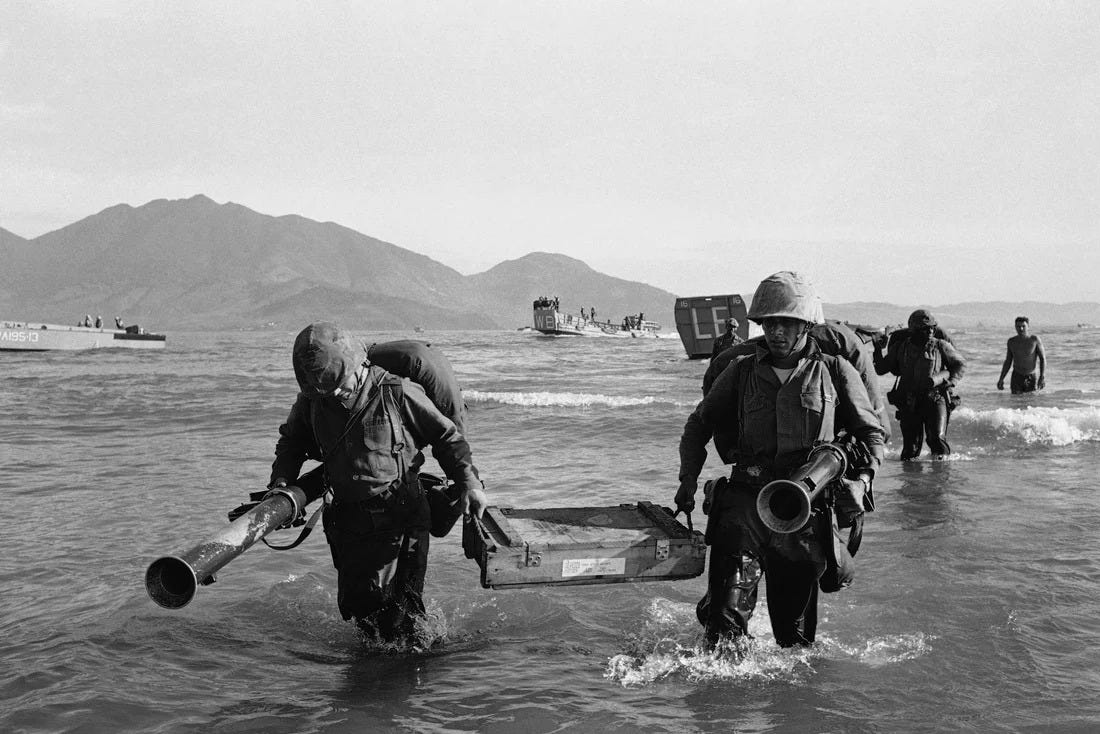
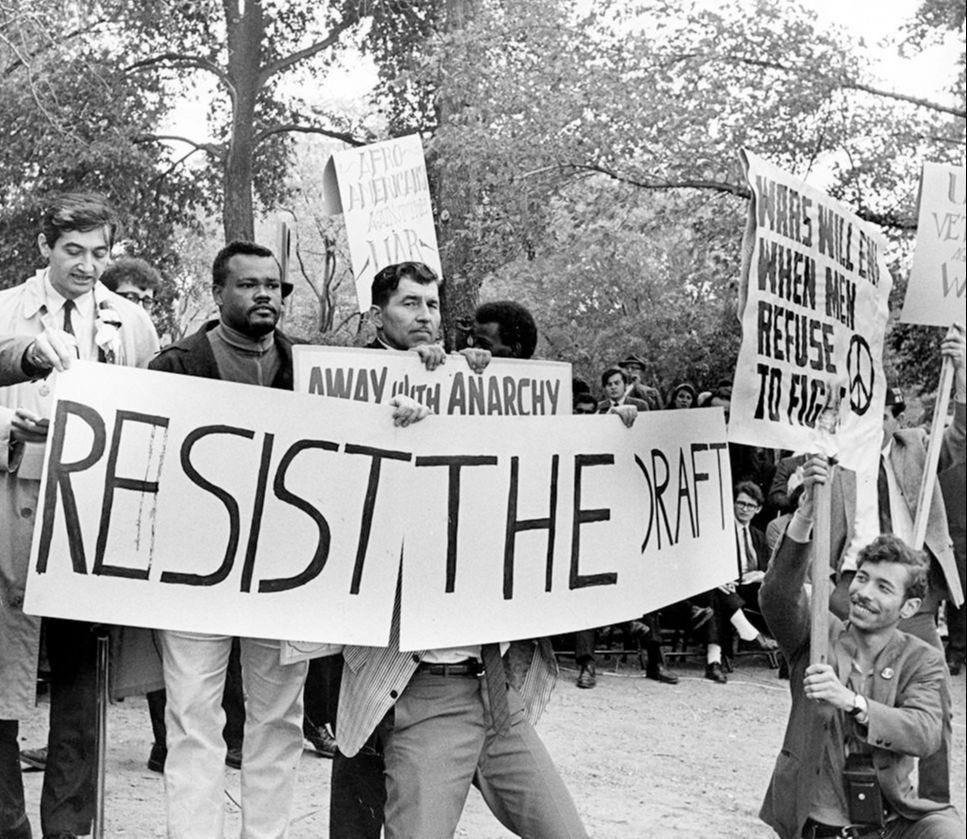
Over the course of the Vietnam War, the United States’ Selective Service System became the target of significant criticism from the American public. One of the draft system’s most criticized elements was the disproportionate number of wealthy and powerful individuals who received deferments from the draft. Americans could obtain a draft deferment if they enrolled in higher education, such as college or graduate school. However, at the time higher education was dominated by and accessible only to wealthy, white Americans. Thus, a clear disparity arose in those being conscripted for military service, with the poor shouldering the burden of going overseas to sacrifice their lives while the elite stayed home.
John Fogerty, Creedence Clear Water’s lead singer and songwriter, had been drafted in 1967 and called up to the Army Reserves. (Here, it is worth noting that Foggerty was never actually sent overseas to Vietnam.) As a self-identified “middle-class white boy” (Alfano), Fogerty was appalled by the preferential treatment the wealthy received. In a 2007 interview with Pitchfork, Fogerty recalled how “it was so glaring … the children of privilege– the senator’s son, the president’s son, … [or daughter’s] boyfriend … were going to have a cushy job somewhere. Whereas the poor, lower class grunt was going to be in a field getting shot” (qtd. in Pitchfork).
Elsewhere, John Fogerty pointed to events like the marriage of Julie Nixon and David Eisenhower that emphasized America’s growing sense of class inequality (Goldberg). The merging of these political dynasties symbolized the consolidation of power, privilege, and influence within the circles of the elite. Fogerty highlights this when he mentions to Rolling Stone that “the whole idea of being born wealthy or being born powerful seemed to really be coming to the fore in the late-Sixties confrontation of cultures” (Rolling Stone). Reflecting the target of Fogerty’s anger, CCR aptly titled their anti-draft song “Fortunate Son,” after the sons of senators and politicians being saved from the draft.
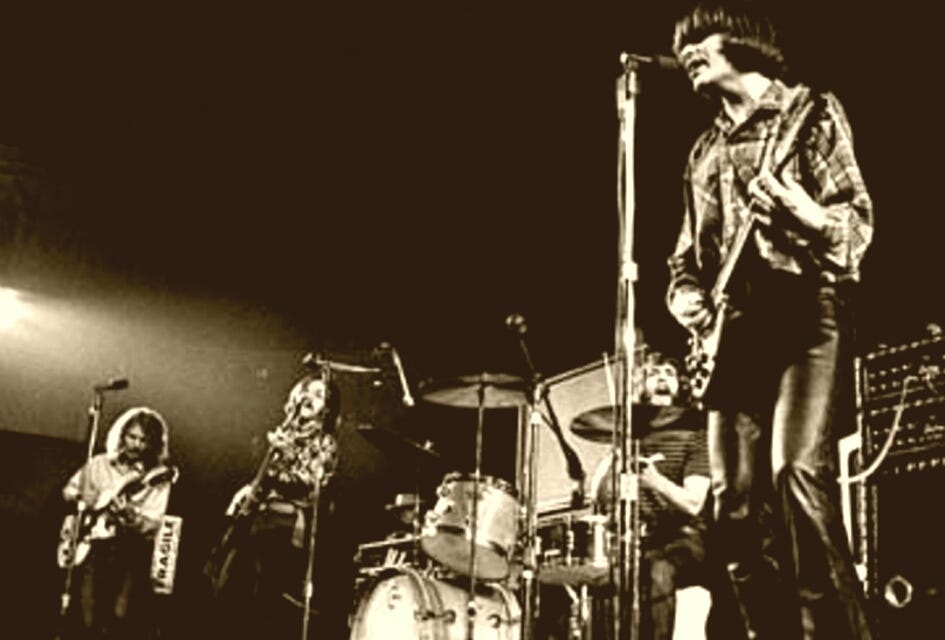
Although “Fortunate Son” contains clear anti-elitist and anti-war sentiments, what truly established the song as one of the most iconic anthems of the Vietnam era was its performance at the 1969 Woodstock Festival. Woodstock drew two main demographics, which attendee Marlene Aron described as “those who some called ‘hippies’ and … the active anti-Vietnam War persons” (Helm 1994, 11). The festival became a nexus for activism and community empowerment, with Aron noting that “at least three-fourths of the people at Woodstock had been protesting or would be protesting the Vietnam War in the not-too-distant future,” driven by a “connection in spirit, a time of activism, of change and purpose and commitment” (Helm 1994, 12).
Aron also reflected that Woodstock served as a space where “400,000 people … shared in the same joy, and feelings of change, and that anything was possible” (Helm 1994, 11). Aron also recalled artists such as Joan Baez and Arlo Guthrie performing songs with “socio-political content,” reinforcing the sentiment that Woodstock was catering to this politically active audience (Helm 1994, 13). Thus, the Woodstock Festival became the perfect opportunity for CCR to cement their song “Fortunate Son” at the forefront of the anti-war and anti-draft movement, as nearly half a million involved and emerging activists attended the festival.
Musical Analysis
“Fortunate Son” is a traditional hard rock / roots rock composition with blues influences. Creedence Clearwater Revival followed the very standard “four-man band” composition of a lead guitarist (John Fogerty), a rhythm guitarist (Tom Fogerty), a bassist (Stu Cook), and a drummer (Doug Clifford), and tended to adopt simple chord progressions in their tracks which is on full exhibit here. The song is written in the key of G Mixolydian, maintaining a I - V - IV - I chord progression (G - F - C - G) for almost the entirety of the piece save the lead breaks. The vocal melody generally plays between F#, G#, B♭, and A. Fogerty starts on the G# (“Some folks-”) before flitting down to the F# for a sixteenth note and bouncing back to G# (“are bo-rn”). Then he holds a dotted quarter on the A (“made”) before going back to G with an F# eighth note on “the” (“to raise the flag”). Finally, he hits the B♭ (“ooh”) and goes back to G# (“they’re red white and blue”). When taken in parts, this vocal melody seems fairly complex, but in practice the song is already fast enough that it almost feels like a one-note melody on the G#. Indeed, you could sing the whole melody on the G# and still find it overwhelmingly recognizable due to how often Fogerty resolves to the G#. The bassline is similarly simple, maintaining a simple walk throughout the piece with the exception of the break. In many ways though, the simplicity of the piece contributed to its iconic nature: the lack of any overly complex melody combined with a simple, easily parsable chorus “It ain’t me, it ain’t me, I [ain’t no senator’s son, son / ain’t no fortunate one, no]” makes the song instantly recognizable from almost any point in its runtime.
Lyrically, the song is fairly blunt. It’s a simple composition, following a refrain-chorus-refrain pattern for three repeats before fading out on a repeated chorus. Fogerty has claimed to have written the piece in around twenty minutes (Kietly), and it shows. Fogerty bends enunciations and inserts “filler” words to create rhymes to resolve to, and frequently speeds up or slows down his vocal delivery to make everything fit within the proper measures. His vocal tone is notably scratchy on this track too, halfway between singing and yelling as he cries “it ain’t me, it ain’t me.” The subject matter of the lyrics is obvious: Fogerty explicitly decries blind patriotism and class differentiation, singing about how the “fortunate” people with political connections (“senator’s son”) or material means (“born, silver spoon in hand”) effectively get to dodge the draft while people of regular means like himself (“it ain’t me”) are not granted these opportunities. This isn’t a song that’s trying to hide its meaning through metaphor or interpretation, it says what it means on its face.
Finally, I’ll note that it’s a very “rough” song from a timbral perspective. As previously stated, Fogerty sings with a scratchy voice and practically yells the chorus, evoking an implicit sense of anger and indignation in his vocal performance. The rhythm guitar hammers away at the chords with a repetitive beating, forgoing any complex strumming patterns. The tone of the lead guitar carries a certain twang that almost evokes the sound of a steel-string acoustic guitar, or possibly even a resophonic guitar. They all add up to make the song feel “rough” or “dirty” or even “angry”, which works well with the indignant nature of the lyrics. It’s the kind of aspect that I suspect wasn’t consciously coordinated, but rather arose naturally out of a group of experienced musicians leaning into a collective feeling. This of course is only speculation though.
Evolving Meaning
The narrative of “Fortunate Son” has undergone a significant transformation since its release in 1969. As mentioned earlier, the song began as a critique of class privilege and systemic inequality during the Vietnam War. Today, though, “Fortunate Son” is frequently associated with broad notions of Americana, appearing in contexts like military events, advertisements, and political rallies, where its original anti-elitist message is reframed or overlooked entirely. To understand how this shift occurred, we will explore the theoretical frameworks of Tia DeNora, Simon Frith, and Charles Hiroshi Garrett. Each of these frameworks provides valuable insight into the processes through which music’s meaning is reshaped by its interaction with social contexts, collective memory, and political forces.
Tia DeNora: The Sociological Construction of Meaning
Tia DeNora’s Beethoven and the Construction of Genius challenges the notion that music’s meaning is intrinsic, emphasizing instead that it is constructed through social and cultural processes. DeNora argues that music’s reception depends on the interpretive frameworks and cultural norms available at the time and the ways it is positioned within specific social contexts (DeNora 1997, 6). In Beethoven’s case, his rise to fame was not simply a result of his talent but also a product of the institutions, patrons, and audiences that shaped and validated his identity as a “genius” composer.
This framework is highly relevant to “Fortunate Son,” as the song’s original meaning was deeply tied to the political and social realities of the Vietnam War. Its critique of privilege resonated strongly with working-class Americans who bore the burden of the draft, while those with privilege escaped it. However, as DeNora explains, “categories of perception… are themselves created and recreated by socially located individuals and groups” (DeNora 1997, 7). In other words, the way music is interpreted is not static but evolves alongside the cultural and social forces that engage with it.
DeNora’s sociological perspective helps explain how the meaning of “Fortunate Son” shifted over time. As the Vietnam War receded into history, the song began to appear in new contexts such as commercials and films that reshaped its reception. Each use aligned the song with the values and needs of these settings, transforming its critique of privilege into a more generalized symbol of Americana.
A prime example of this is the song’s appearance in the 1994 movie Forrest Gump (1994). The use of “Fortunate Son” in this film recontextualized it as a nostalgic marker of the 1960s, focusing on the era’s imagery rather than its original political critique. In the film, it plays during a Vietnam War montage, tying it to the broader cultural memory of the time rather than its critique of privilege. Its use in Wrangler commercials (2002) repurposed its rebellious energy to promote themes of toughness and self-reliance, often linked to the American frontier and cowboy culture. This reframing aligned the song with rugged individualism, moving it away from its original focus on inequality and protest. DeNora’s insights highlight how such recontextualization reflects changing cultural and social frameworks, illustrating a broader dynamic within public memory where cultural artifacts like “Fortunate Son” are continually redefined to align with the shifting values and narratives of the societies that engage with them.
Charles Hiroshi Garrett: Sociopolitical Reframing
Charles Hiroshi Garrett, in “Chinatown, Whose Chinatown?”, highlights how music is frequently recontextualized in response to shifting contemporary socio-political agenda. Garrett’s main emphasis, however, is that the song’s orientalist roots persist through these reinterpretations despite attempts to overshadow its original racist connotations. He recounts that he has yet to come across evolving renditions of the song “Chinatown, My Chinatown” that do not still retain a significant degree of the song's original intent (Garrett 2004, 165). This is unsurprising given that his framework specifies that it requires continuous maintenance and reinscription (Garrett 2004, 124) to reconstruct meaning. This underscores that a song cannot fully separate itself from its origins, though the protest message can shift as contemporary issues arise.
Garrett’s framework helps unpack the layered recontextualization of “Fortunate Son,” particularly in its appropriation for the Wrangler campaign and use in the movie Forrest Gump. Namely, this aligns with Garrett’s observation that the uses of songs begin to change in response to various cultural factors and broader historical shifts (Garrett 2004, 124). As a result, the work of “Fortunate Son” should be understood not only with respect to Fogerty’s original conception but also consider moments at which producers have been drawn to it (Garrett 2004, 124). This recontextualization demonstrates Garrett’s point that a song's meaning is shaped by the current context of its use. Rather than a static cultural artifact, “Fortunate Son” becomes a flexible symbol often molded for the messages of those repurposing it.
While the Wrangler commercial and Forest Gump seem to stray from the song's original anti-elitist message, the use of it in this context retains its tone of protest. Specifically, by preserving the song's populist appeal. Simultaneously, these uses in media reflect Garrett’s idea that it is not entirely possible to purge a song of its protest roots; instead, the focus of its critique evolves, taking on a voice that speaks to the other side of the political spectrum.
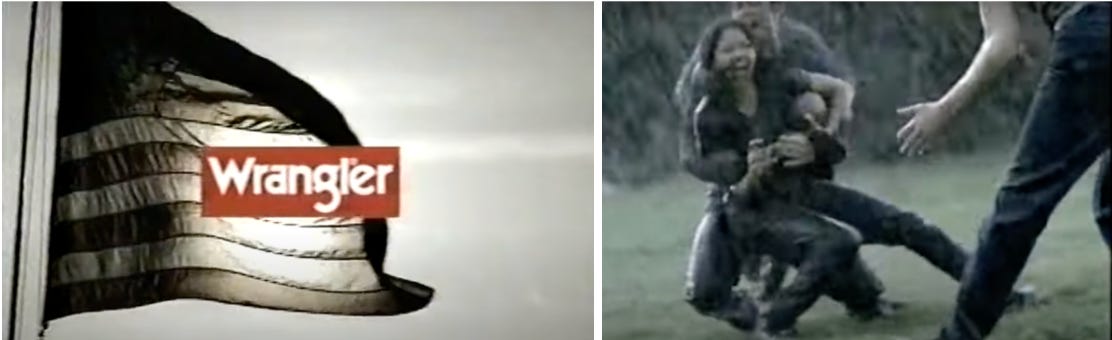
By engaging with the song in this way, Wrangler seeks a defiant rebellious energy while redirecting anger toward being a strong, rugged American. These values are emitted through the commercial with the use of the frames pictured in Figure 5. Here, patriotism and American values are evident, meaning that the accompaniment of “Fortunate Son” pushes a similar anti-posh agenda. This repurposing of an artwork’s origins and its modern uses reflects the power of music to adapt to new agendas while retaining its original roots.
Reframing “Fortunate Son” Through Collective Memory
Simon Frith's article, "Rock and the Politics of Memory," explores collective memory and provides a framework for understanding how cultural artifacts like “Fortunate Son” change meaning over time. Frith argues that music serves as a bridge to collective memory and is continuously reshaped to reflect the cultural and political demands of the present (Frith, 69). This process often results in music being absorbed into mainstream narratives in ways that obscure or completely distort its original intent. For instance, Frith discusses how albums like Sgt. Pepper's Lonely Hearts Club Band now evoke nostalgia rather than embodying the political optimism they once symbolized (Frith, 60, 68-69). At its release, the album was seen as bold and innovative, capturing the belief that music could push boundaries and address societal issues. Over time, however, its innovative spirit was redefined through collective memory as a hallmark of the “swinging sixties,” with its political significance overlooked (Frith, 60, 68-69). Frith illustrates this example to show how collective memory selectively preserves certain aspects of cultural artifacts while sidelining others, reshaping music’s meaning to fit emerging cultural narratives.
In the case of “Fortunate Son,” Frith’s ideas provide a framework to analyze how its role within collective memory has been reshaped through its placement in contexts that diverge significantly from its original purpose. At Veterans Day concerts in 2014, the song was positioned as a symbol of shared national pride. Its meaning was repurposed to fit a celebratory and unifying context, framing it as a nostalgic anthem that reinforced national unity. Similarly, at Donald Trump’s campaign rallies, the song was recontextualized to resonate with populist themes. In both cases, “Fortunate Son’s” original anti-elitist message was nowhere to be found and it was reframed to serve broader narratives of defiance and national identity.
These shifts reflect what Frith identifies as the “double setting” of music, where songs retain fragments of their original meanings while being repurposed to meet the cultural and political demands of new contexts (Frith, 69). Collective memory plays a crucial role in this process, as it selectively preserves and reinterprets aspects of a song’s history to align with present-day values and narratives. In the case of “Fortunate Son,” collective memory enabled the song to serve both as a patriotic anthem at Veterans Day concerts and as a populist rallying cry at Donald Trump’s campaign events. Through this dynamic, “Fortunate Son’s” critique of privilege was muted, while its broader associations with rebellion and Americana were amplified. This demonstrates how collective memory works in unison with Frith’s idea of “double setting” to obscure a song’s original critique.
Connecting the Frameworks to “Fortunate Son”
The frameworks of DeNora, Frith, and Garrett work in conjunction to highlight the processes through which “Fortunate Son” has been reinterpreted over time. DeNora’s focus on the sociological construction of meaning explains how the song adapted to our modern day political and social contexts. Additionally, Frith’s exploration of collective memory illustrates how “Fortunate Son” became absorbed into modern culture, as the populist and patriotic appeal of Trump’s rallies overshadowed the song’s original anti-elitist sentiment. Similarly, Garrett’s analysis of socio-political pressures highlights the tension between the song’s original intent and its current uses, illustrating its position as a flexible symbol of current ideals, rather than a defined political art piece.
Together, the insights of these frameworks reveal how “Fortunate Son” has transitioned from a critique of systemic inequality to a flexible cultural symbol. This evolution demonstrates the power of music to reflect and adapt to changing social and political landscapes, while also highlighting the risks of losing sight of its original purpose.
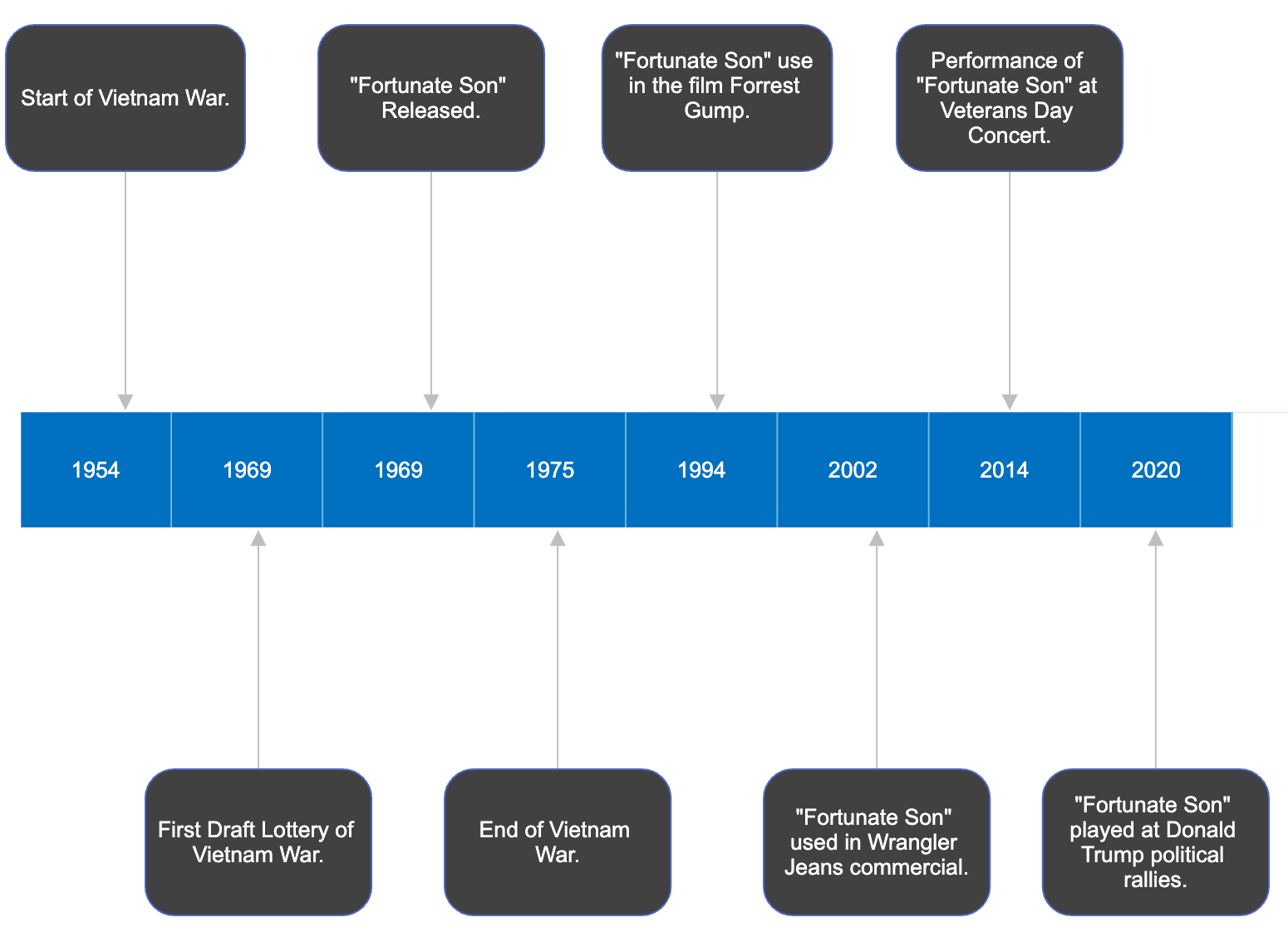
Contradictory Use in Trump’s Campaign
From the timeline, one sees that “Fortunate Son” has been used and reinterpreted numerous times since its inception. As mentioned earlier, one of the most contradictory instances of this is the song’s use in the Trump 2020 presidential campaign. This section explores how a candidate who is famous for dodging the draft, wielding political power, and otherwise being “born silver spoon in hand” can co-opt a song explicitly written as a critique of the privileges afforded to the financial and cultural elite.
To understand this event, one cannot just examine the song itself. Musicologist Christopher Small believes that “the fundamental nature and meaning of music lie not in objects, not in musical works at all, but in action, in what people do. It is only by understanding what people do as they take part in a musical act that we can hope to understand its nature and the function it fulfills in human life” (Small 2016, 102). Although this post focuses on a specific musical object, “Fortunate Son,” it is peoples’ interaction with the song and the context in which it is played that makes it an interesting study of how musical meaning and identity is shaped by social and cultural contexts.
The clip below presents just how people interact in the context of Trump’s campaign rallies. Political scientist Corina Lacatus explores Trump’s tweets and rally speeches and outlines how “populist politicians favor [these] un-mediated forms of communication” (Lacatus 2020, 37). He wants his supporters to feel that he is speaking directly to them in a way that is more raw and honest than the “fake-news” mainstream media. It's interesting to note that Trump aspires to the tone of straightforward and unfiltered anger that Fogerty encapsulates in “Fortunate Son.” Following this style, Trump uses direct language, repetition, and variations of speed and wording. To notice these similarities pay attention to the phrases, “you were forgotten; they forgot about you” and “you’re the elite; you are the elite”.
As demonstrated here, these rallies are high-energy, informal, and even participatory. Familiar with his rhetoric, the crowd knows when to laugh, cheer, or, most notably, boo at the mention of the elites. This is interesting as Trump is certainly someone considered elite, especially by Fogerty’s calculations. However, this is not how he positions himself with regard to the American political establishment. He wants people to view him as an outsider to Washington, and in doing so creates an altered definition of the “elite” for his supporters. Fogerty writes from the anger of seeing that only poor or middle-class people were being drafted while the “millionaires’” and “senators’ sons” were untouched. Trump’s rhetoric likewise relies on the idea that he is being unfairly targeted by the establishment. Thus, he is able to tap into the sense of persecution but also resistance implicit in the lyrics of “Fortunate Son.” Through this process, he obscures the original discussion of class to create a more abstract idea of a political elite pursuing him as part of their broader campaign against the prosperity and “traditional American values” he has sworn to protect (Lewsey 2024).
Broader Implications
The distortion of CCR’s “Fortunate Son,” from a searing critique of systemic privilege to a misunderstood anthem of patriotism, exemplifies broader trends in how art is reshaped by societal and political forces. As noted in the Historical Context section, the performance of “Fortunate Son” at the 1969 Woodstock Festival cemented its status as an anti-war cultural phenomenon. With an audience of nearly half a million activists and countercultural figures, the festival served as the ideal platform for Creedence Clearwater Revival to amplify the song’s anti-elitist and anti-draft message. However, the simplicity that made “Fortunate Son” a powerful and accessible protest song also left it vulnerable to reinterpretation. As discussed in the Musical Analysis section, its straightforward melody and memorable chorus ensure its lasting cultural relevance but also make it easily repurposed for political agendas, as seen in Trump’s campaign rallies. In Trump’s context, “Fortunate Son’s” original critique of privilege was sanitized and repurposed to evoke sentiments of patriotism and populism. This highlights that there is a broader issue with protest music. Specifically, in how a song’s simplicity can contribute to its lasting appeal but also makes it easier to manipulate for media and political agendas.
Therefore, it can be seen that “Fortunate Son” serves as a case study of the troubling trend in which art is co-opted and recontextualized to serve chosen narratives, often diminishing its original messaging. Dana Gorzelany-Mostak highlights this phenomenon in her book Tracks on the Trail when she analyzes Ben Carson's 2016 presidential campaign. She emphasizes how the campaign “[revoiced] a White artist, Eminem, through Black gospel … [asserting] political solidarity with his White Republican counterparts, by extension making the claim that blackness can represent whiteness” (Gorzelany-Mostak 2023, 61). This repurposing of Black gospel music to make white conservatives more comfortable with supporting a black presidential candidate perfectly exemplifies how music can be manipulated to serve new agendas.
Similarly, the use of “Fortunate Son” in Trump’s campaign rallies demonstrates how messages rooted in anti-elitism and social injustice can be sanitized and weaponized to evoke contradictory sentiments of patriotism and populism. This process not only dilutes “Fortunate Son’s” original power to challenge inequalities—inequalities that persist to this day—but also raises the question of the fragility of collective memory. Ultimately, “Fortunate Son’s” reinterpretation underscores the vulnerability of cultural works in an era where its meanings are increasingly mediated by political convenience, demonstrating how public memory often preserves the form of protest, while erasing its substance.
Conclusion
This deep dive into the transformation of “Fortunate Son” reveals the complex interplay between art, society, and politics. What began as a searing critique of systemic privilege during the Vietnam War has been reshaped into a cultural artifact that adapts to evolving narratives over decades. Its use in films, commercials, and political campaigns demonstrates how music’s meaning shifts when it intersects with collective memory and socio-political agendas. The frameworks of Tia DeNora, Simon Frith, and Charles Hiroshi Garrett help explain this process, showing that music’s meaning is not fixed, but shaped by the context and audiences that engage with it.
The evolution of “Fortunate Son” highlights how songs can remain culturally relevant by being recontextualized for new purposes but these shifts can often obscure their original intent. Its changing meaning challenges us to critically examine why and how cultural works are adapted to fit new narratives. By understanding these transformations, we can better preserve the significance of the original message while recognizing its continued relevance in shaping collective memory and reflecting societal change.
Works Cited
Alfano, Sean. “John Fogerty’s Musical Revival.” CBS News, CBS Interactive, 28 Nov. 2005, www.cbsnews.com/news/john-fogertys-musical-revival/.
Basner, Dave. “8 Rockers Who Are Also Veterans.” iHeart, November 11, 2021. https://www.iheart.com/content/2019-11-11-8-rockers-who-are-veterans/.
DeNora, Tia. Beethoven and the Construction of Genius: Musical Politics in Vienna, 1792–1803. University of California Press, 1997.
“The Draft and the Vietnam War.” Students of History. Accessed December 9, 2024. https://www.studentsofhistory.com/vietnam-war-draft.
Einav, Dan. “Fortunate Son” - Creedence Clearwater Revival’s Era-Defining Anthem of Dissent.” FT.Com, The Financial Times, 5 Aug. 2019, ig.ft.com/life-of-a-song/fortunate-son.html.
Fogerty, John. 2024. The Day I Wrote Fortunate Son. https://www.youtube.com/watch?v=6s6ENqy395E.
“Fortunate Son.” Fogerty 1993 Rolling Stone Interview, riverising.tripod.com/john-interviews/rollingstone2.html. Accessed 26 Nov. 2024.
Frith, Simon. 1984. “Rock and the Politics of Memory.” Social Text, no. 9/10, 59–69. https://doi.org/10.2307/466535.
Garrett, Charles Hiroshi. "Chinatown, Whose Chinatown? Defining America's Borders with Musical Orientalism." Journal of the American Musicological Society, vol. 57, no. 1, Spring 2004, pp. 119–174. University of California Press. https://www.jstor.org/stable/10.1525/jams.2004.57.1.119
Gorzelany-Mostak, Dana. “Anatomy of a Campaign Launch: Heal, Inspire, Revive, Erase with Ben Carson.” In Tracks on the Trail: Popular Music, Race, and the US Presidency, 49–65. University of Michigan Press, 2023. http://www.jstor.org/stable/10.3998/mpub.12654659.6.
Helm, Chris. Woodstock, NY (Marlene Aron Personal Experience). Other. Youngstown State University Oral History Program. Youngstown State University, October 24, 1994.
“John Fogerty.” Pitchfork, 27 Nov. 2007, pitchfork.com/features/interview/6737-john-fogerty/.
Kasper, Eric T. You Shook Me All Campaign Long: Music in the 2016 Presidential Election and Beyond. Denton: University of North Texas Press, 2018. https://muse.jhu.edu/book/67345.
Kietly, Martin. “John Fogerty Recalls ‘Intense’ Experience of Writing ‘Fortunate Son’”, Classic Rock and Culture, 1 Dec. 2018. https://ultimateclassicrock.com/john-fogerty-fortunate-son-writing/
Kopp, Bill. “Played a Set for Everyone: Creedence Clearwater Revival at Woodstock.” Rock and Roll Globe, August 22, 2019. https://rockandrollglobe.com/rock/played-a-set-for-everyone-creedence-clearwater-revival-at-woodstock/.
Lacatus, Corina. “Populism and President Trump’s Approach to Foreign Policy: An Analysis of Tweets and Rally Speeches.” Politics 41, no. 1 (July 28, 2020): 31–47. https://doi.org/10.1177/0263395720935380.
Lewsey, Fred. “Vast Majority of Trump Voters Believe American Values and Prosperity Are ‘under Threat.’” University of Cambridge , November 11, 2024. https://www.cam.ac.uk/stories/trump-voters-2024 .
Small, Christopher. “Introduction to Musicking. Prelude: Music and Musicking .” Essay. In The Christopher Small Reader, edited by Robert Walser, 95–113. Middletown , CT: Wesleyan University Press, 2016.
Spector, Ronald H. “The United States Enters the War.” Encyclopædia Britannica, 19 Nov. 2024, www.britannica.com/event/Vietnam-War/The-United-States-enters-the-war.
Sullivan, Michael. “In Danang, Where U.S. Troops First Landed, Memories of War Have Faded.” NPR, May 2, 2015. https://www.npr.org/sections/parallels/2015/05/02/403597845/in-danang-where-u-s-troops-first-landed-memories-of-war-have-faded
“Trump: ‘You are the Elite’.” Posted August 4, 2018, by CBS News. YouTube, 1 min., 34 sec. https://www.youtube.com/watch?v=r8HOvlqckeU.
 | A guest post by
|
 |
|
 |
|
 |
|
 |
|